
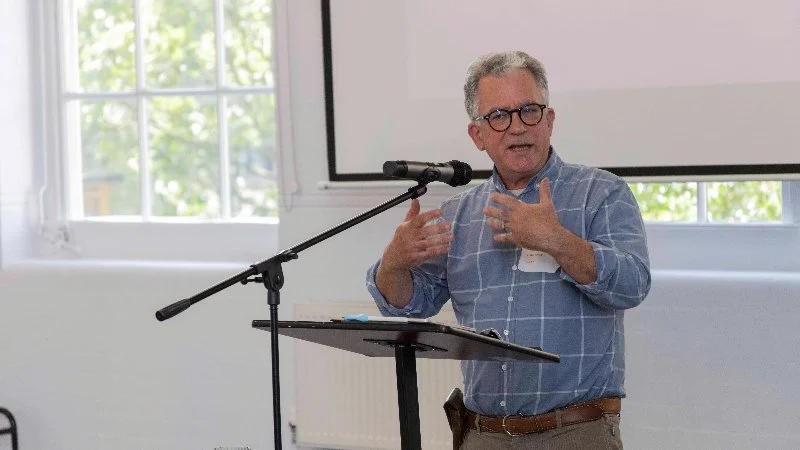
Dr Austen Ivereigh, speaking at Centre for Catholic Socal Thought and Practice study day, June 2026
In June 2026, the CCSTP study day focused on being human in a digital age, inspired by the recent publication of Pope Leo’s encyclical, Magnifica humanitas,. Academics and practitioners from a range of different organisations and insitutions gathered to discuss, ask questions and hear from a panel of speakers.
In this short blog series, David Byrne from Caritas Social Action Network, gives his personal reflections on the issues raised by the day.
Reflecting on Magnifica humanitas in person
Any serious conversation about AI is, almost immediately, an invitation to ask a much deeper question: who are we? What do we think a human person is? What have we forgotten about ourselves that makes it possible to be so dazzled, unsettled, or even seduced by something which mimics us but is not us?
We seem to stand at a moment of profound existential doubt, in which some are increasingly tempted to abandon the difficulty of other human persons in favour of smoother, more controllable, digitally-mediated forms of “relationship”. That makes question of theological anthropology all the more urgent.
AI is not human. It has no body, no conscience, no soul, no vocation, no capacity for grace, repentance, prayer, or love. And yet it increasingly presents itself to us in forms that feel pseudo-human. For that reason, it was an especial delight to reflect on Magnifica Humanitas in person, in a room full of incarnate, discerning persons: thinking, listening, laughing, questioning, disagreeing, and trying together to ask what it means to remain human.
Learning how to love, believe, hope and act in a wounded world
The opening sessions of the study day helped me to see more clearly the difference between Christian hope and technological optimism.
Anna Rowlands’ introduction was especially helpful here. Her reference to Hannah Arendt being drawn to Augustine – because she wanted to know how to love the world in all its brokenness and sinfulness – felt like a really powerful way into the day. It suggested that Catholic social thought is not just about having the right principles, but about learning how to love, believe, hope, and act in a wounded world.
What struck me is that Christian hope is rooted in faith: faith in God, yes, but also a kind of “natural” faith in humanity. Not humanity as a set of isolated individuals, but humanity as interdependent, communal, capable of collective organising, and capable of working together for the common good in love and solidarity.
Hope, in the temporal sense, is almost essentially a corporate enterprise. It depends upon the activity of others, and upon the integrity and quality of our relationships with them. That feels very different from a thin optimism that simply assumes progress will happen because technology becomes more powerful.
The dangers of anonymous power
Austen Ivereigh’s talk sharpened this for me. His point that the encyclical is not finally “about the tech,” but about power and the human desire to transcend finitude, helped me think about technological optimism in a more serious way.
Watch Austen Ivereigh’s full talk here.
Technology is not opposed to Christian hope. It can help us hear the cry of the poor, communicate suffering that might otherwise remain hidden, and alleviate undignified forms of suffering, especially where illness or disability cuts people off from a full and dignified participation in society and community.
But technological optimism, when divorced from Christian hope, tends towards an idolatry of the human capacity to master the world. It can lead to a mindset where limits are transgressed for the sake of a short-sighted “progress” where the poor, the vulnerable, and the environment are trampled underfoot for the sake of some temporal good (often masquerading as a pseudo-eternal good). A utilitarian, ends-justify-the-means logic creeps in. It can even become a kind of neo-Pelagianism: a belief that we can save ourselves through the tools, systems, and powers we have created.
Austen’s discussion of anonymous power was especially powerful. AI and automated systems can lengthen the chains of accountability and obscure the hierarchies of responsibility. Decisions are made; harms are caused; but responsibility becomes harder to trace. Evil becomes more remote, more faceless, more removed from human moral discernment. That is a very dangerous thing.
The importance of discernment
The Christian response cannot be nostalgia or panic. It has to be discernment, and a renewed modelling of moral accountability. That means being explicit about power and how it is used and abused in very concrete ways, including within the Church: structures of decision-making, consultation, apology, reconciliation, and avenues for action from parish to Vatican.
It also means recovering subsidiarity, because no algorithm can discern what a particular parish or local community needs in response to the signs of the times. Only a real process of listening, prayer, and discernment with the Holy Spirit can do that. Technology may help with implementation. It cannot replace discernment.
Read further reflections from the day and watch talks from Dr Samuel Tranter and Dr Amy Daughton.