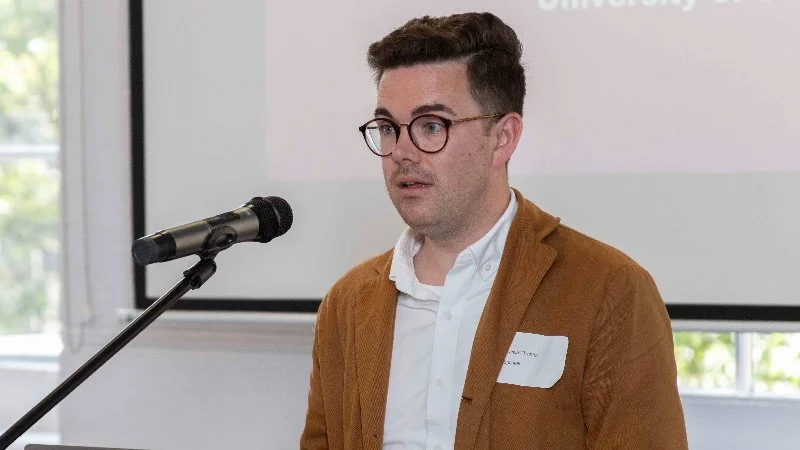
Dr Samuel Tranter, speaking at the Centre for Catholic Social Thought and Practice study day, June 2026.
In June 2026, the CCSTP study day focused on being human in a digital age, inspired by the recent publication of Pope Leo’s encyclical, Magnifica humanitas,. Academics and practitioners from a range of different organisations and insitutions gathered to discuss, ask questions and hear from a panel of speakers.
In the second in a short blog series, David Byrne from Caritas Social Action Network, gives his personal reflections on the issues raised by the day.
Sam Tranter’s lecture helped me to think about technology in a way that was neither naïve nor reactionary. Technology is not simply “bad”, nor is it some alien force dropped into human life from the outside. It is a product of human creativity. But that is exactly the point: it is a product of human creativity, not a replacement for it.
Watch Dr Samuel Tranter’s talk here.
This seems to me to be one of the places where we need to sharpen our language. AI is remarkable. Of course it is. It can mimic certain human capacities with astonishing speed and fluency. But we need to be much clearer when we are speaking metaphorically.
AI does not “think” or “create” or “discern”. Only the human person does. It chops up and recombines what it has been trained on. It recognises patterns. It can produce something coherent, even impressive. But it is not a person, graced with the infinite dignity of bearing the image and likeness of the Trinity. It is not a moral agent. It has no conscience. It has no point of contact with the promptings of the Holy Spirit.
Technology is not neutral
That is why I find it increasingly inadequate to say that AI is “just a tool.” A spade or a spanner is more clearly morally inert. A spade can cultivate the soil to grow food, or it can be used as a weapon. A spanner can tighten a bolt so that we can drive safely, or it too can be misused.
But AI is not like that in any simple sense. It is trained on vast amounts of human writing, thought, desire, prejudice, beauty, sin, virtue, confusion, longing – the whole messy admixture of human life. But unlike a human being, it cannot repent. It cannot pray. It cannot discern. It cannot be converted.
This is what made Sam’s insistence that technology is not neutral so important. AI is being developed by networks of powerful people and institutions, many of them shaped by commercial interests, even where there are also good intentions.
It is often designed as a consumer product, not as a servant of the common good. And we can already see the effects of that. It “flatters” and “pleases” and “grovels” to keep people engaged. It can “speak” in a confident, pseudo-personal tone with an audacious air of authority. And yet, it knows nothing of wisdom or the things of God.
Losing parts of our humanity
That worries me, especially in spaces of formation. It worries me for young people who are still learning how to think, how to write, how to disagree, how to be challenged, how to find their own, God-given voice. If we outsource too much to AI, we risk losing not only skills, but parts of our humanity: the messy, difficult, embodied labour of becoming people capable of discerning the truth and bringing it into being.
So I do not think the Church can treat this as a niche issue. Nor do I think the answer is simply to outline a set of guidelines for engaging with AI. I almost want to resist answering too quickly. The point is that this has to remain an ongoing ecclesial conversation and a real work of discernment. We need to learn, synodally, how to use these technologies without letting them deform us.
And here the Church has something prophetic to offer. Real dialogue is not frictionless. It is full of awkwardness, disagreement, emotion, laughter, silence, misunderstanding, reconciliation. It happens between bodies and faces, not just between prompts and outputs. None of that is an inefficiency to be overcome. It is part of the labour of love. It is part of how we become human together, covered in blood, sweat and tears.
Work as a site of community and connection
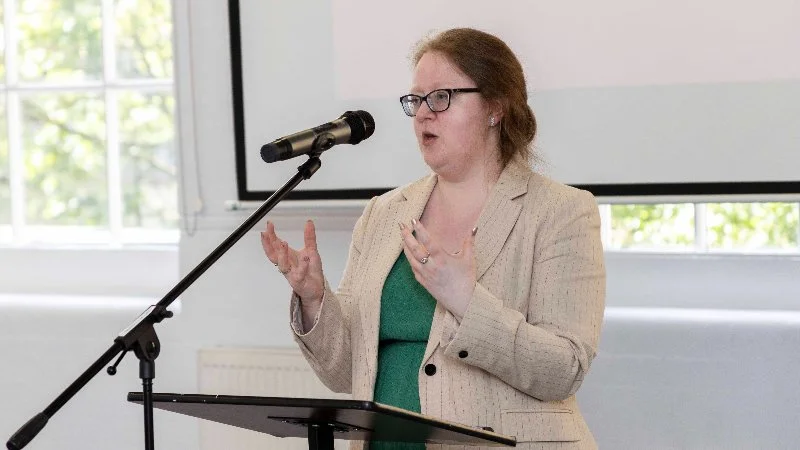
Dr Amy Daughton speaking at the Centre for Catholic Social Thought and Practice study day, June 2026
Amy Daughton’s lecture helped me to see that the future of work cannot be reduced to questions about jobs, wages, efficiency, or productivity. Work, in the Catholic Social Teaching tradition, is something much deeper than that. It ought to be a proper site of community and communion: a place of participatory co-creation, where we labour with our brothers and sisters to bring about God’s Kingdom on earth.
Watch Dr Amy Daughton’s talk here.
That matters because work is too often spoken of as though it were simply a punishment, a burden, or a necessary evil. But the Catholic vision is much richer and more beautiful than that.
Work is a context in which we discover who we are. It is where vocations are found, tested, and nurtured. It is where we learn from masters, guides, colleagues, and mentors. It is one of those special places of formation where we are helped to become the persons God is calling us to be, while contributing to the common good and to the in-breaking of the Kingdom.
This is also why it matters so much that Amy spoke about both paid and unpaid work. The Gospels never tire of warning us about the dangers of money, riches, and wealth. Luke’s Gospel, at times, seems to stop only just short of treating excessive wealth itself as an intrinsic evil.
So the value of work simply cannot be measured by how well it is financially remunerated. In fact, as David Graeber argues in Bullshit Jobs, there is often a grotesque mismatch between the social value of work and the financial rewards attached to it. Some of the most necessary, tender, humanly important work is badly paid or not paid at all.
So we need other ways of speaking about value. Not in a way that excuses poverty wages – absolutely not. People must be paid enough to live in accordance with their existential dignity. But we also need to resist the lie that money alone reveals the true worth of work.
Setting new norms about the nature of work
This is where AI becomes so dangerous. The problem is not simply that AI might “take jobs.” In some cases, there may be repetitive, dangerous, dehumanising work that we would be glad to see automated, especially where it damages people’s health, shortens lives, or contributes to chronic illness. The more profound issue is that AI may begin to set the norms for what work ought to be: tireless, frictionless, endlessly ongoing, output-driven. In short, a site of perpetual restlessness.
That is the real danger. We must be regularly reminded that AI is only a form of technology. It must not be treated as a replacement for the human person in situations where the human person is irreplaceable. One can only imagine the indignity of using AI to provide “entertainment” or “social interaction” for elderly people, many of whom are already trapped in prisons of loneliness in care homes and nursing homes. If AI has any legitimate place there, it should be to free medical and care professionals to spend more time with people: to speak, listen, comfort, laugh, notice, remember, and simply be present. That ordinary human interaction is priceless. It is also work, and it should be honoured and properly paid.
Amy’s lecture also made me think about Sabbath. AI does not sleep. It does not tire. It does not need leisure, prayer, recreation, or rest. But we do. If we model working culture on machines rather than Scripture, we risk normalising 24/7 work and allowing ourselves to be subordinated to the punishing logic of relentless production.
We need a culture of Sabbath and absence from technology, not because rest is an escape from life, but because without it, we lose what it means to be God’s people – called out from Egypt to worship him, to rest in him.
Hence, we need to think much more seriously about how we differ from technology through our practices of resting. Leisure and re-creation are useless according to a neoliberal logic of hyperproduction and overconsumption.
They are forms of protest against this diabolic world and participative retreats to which allow us to join in God’s recreation of the world, in the inauguration of the heavenly Kingdom. Even at the Requiem Mass we pray, “Eternal rest grant unto them, O Lord.” We were made for holy work, yes – but not for work without end. We were made for communion, for worship, for love, and finally for rest in God.
Read more about the CCSTP study day and watch Professor Carmody Grey’s talk.