
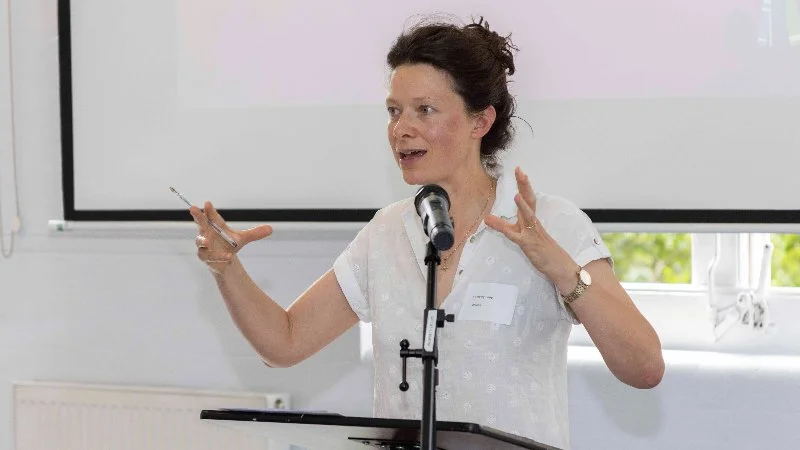
Professor Carmody Grey speaking at Centre for Catholic Social Thought and Practice study day, June 2026
In June 2026, the CCSTP study day focused on being human in a digital age, inspired by the recent publication of Pope Leo’s encyclical, Magnifica humanitas. Academics and practitioners from a range of different organisations and insitutions gathered to discuss, ask questions and hear from a panel of speakers.
In the third in a short blog series, David Byrne from Caritas Social Action Network, gives his personal reflections on the issues raised by the day.
Carmody Grey’s lecture was probably the one I found most challenging and probably for that reason, one of the most useful.
Watch Professor Carmody Grey’s talk here.
It forced the whole conversation about AI and technology back within the frame that Pope Francis always sought to foreground integral ecology and integral human development. That matters, because the risk with the advent of a new technology is that we slip imperceptibly into a problem-solving, analytic register. What can we build? What can we optimise? What can we fix? What can we make more efficient?
But Laudato Si’ asks us to begin somewhere else. The world is not first of all a problem to be solved, but a gift to be received. That is such an important correction. We need a more poetic, receptive engagement with creation: a sense of wonder and awe, an open-armed receptivity, a deeply-felt gratitude for God in creation, with all his manifold traces and explicit signs. The Eucharistic, sacramental logic of Christian life begins not with mastery, but with thanksgiving.
Is AI intrinsically dehumanising?
At the same time, I found myself resisting any suggestion that AI is necessarily dehumanising simply because it is disembodied, artificial, or mediating. Human beings have always related to one another through mediation: letters, books, music, icons, phone calls, emails, prayer across distance. Mediation is not the enemy of embodiment per se. What matters is whether a technology tries in vain to “replace” the human person where the human person is irreplaceable, or whether it frees us to become more human.
That distinction is absolutely crucial. AI may be dehumanising when it is used as a substitute for companionship, careful discernment, moral responsibility, or embodied human encounter. The thought of AI being used to provide “social interaction” for lonely elderly people, for example, seems degrading if it becomes a replacement for concrete acts of co-presence.
But AI might also be rehumanising if it takes on work that is itself dangerous, exhausting, degrading, or harmful, or if it helps us detect cancerous cells, predict climate disasters, map deforestation, monitor greenhouse gas emissions, or identify communities vulnerable to flooding.
In those cases, technology may help release human beings for the work only human beings can do: sitting with the sick, visiting those in prison, negotiating peace, feeding the hungry, accompanying the lonely, and doing the hard, messy, incarnate work of Caritas.
So perhaps the point is not to reject AI as such, but to insist upon an incarnate spirituality in our use of it. AI must remain a tool. It must not become a “person” that we imagine ourselves to be speaking with, trusting, obeying, or loving. It has no final cause of its own. It is endlessly open to the purposes placed upon it. That is why the question of who controls it, who profits from it, who is harmed by it, and what ecological costs it carries must continually be considered.
An integral ecology is indispensable
AI and digital technology cannot be allowed to develop as though they were absolute goods. Just because we can develop them at this pace does not mean we should, especially if doing so accelerates climate change, deepens resource extraction, increases energy use, contributes to ecological collapse, or worsens the displacement of people from their homes. There is no healthy technological future without a habitable earth.
Carmody’s lecture helped me see that Catholic Social Teaching must resist both technological idolatry and ecological nostalgia. We need to build, yes. Human beings are makers. But we must not forget how to receive. Before we solve, we must contemplate. Before we optimise, we must give thanks. Before we ask what AI can do, we must ask what kind of world it is being built within, and whether it helps us love that world more truthfully.
Reflections on the study day
I left the study day grateful: grateful to CCSTP, and grateful for the prophetic voices who helped us think with such seriousness, patience, and theological imagination.
Magnifica Humanitas feels to me like a landmark document, the fruit of years of careful ecclesial discernment, written for the People of God who are presently facing a genuine change of era and a future that remains radically unknown. No one pretended that the way forward is simple. We were not being handed any finalised conclusions.
We were being invited to discern the signs of the times together, and to ask how we, as wonderful human persons, images of the divine, can continue faithfully putting one foot in front of the other: resisting despair, refusing idolatry, receiving the world as gift, and learning again how to love it and love each other as Christ calls us.
Watch recordings of all the talks on the CCSTP youtube channel.